
The Hardware Breakthrough: How NVIDIA RTX Spark is Changing Laptops Forever
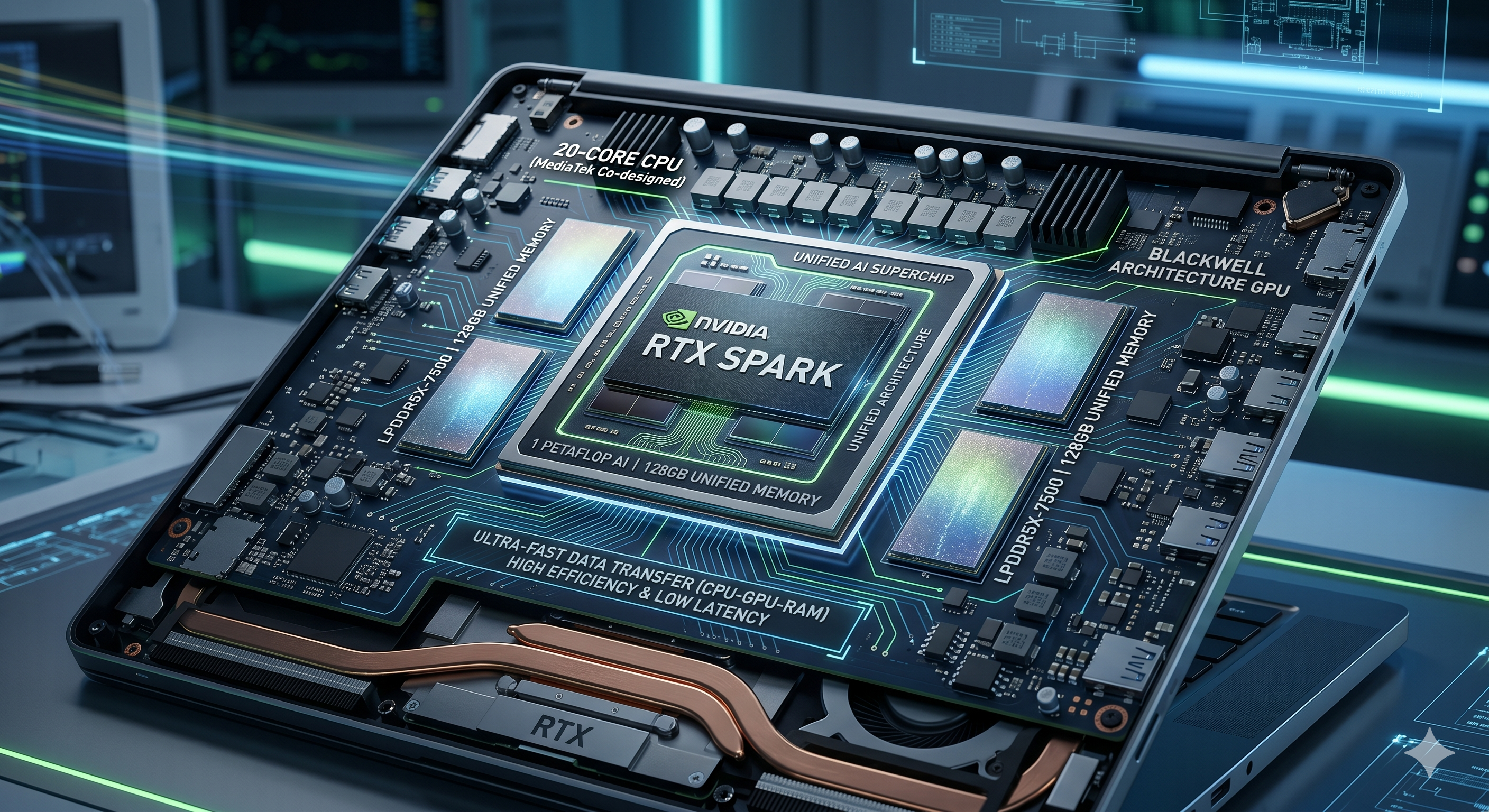
The tech world just experienced a massive earthquake. NVIDIA and Microsoft joined forces to unveil the NVIDIA RTX Spark—a brand-new type of computer chip designed for upcoming Windows laptops and compact desktops.
NVIDIA CEO Jensen Huang announced that this chip shifts the personal computer from a mere "tool" to an active "teammate."
But what actually is the RTX Spark, how does it work, and what does it mean for regular users, gamers, and creators? Let's break it down in plain, jargon-free English.
What is the RTX Spark? (The "Superchip" Explained)
In a traditional computer, you have separate components: a Central Processing Unit (CPU) acting as the main brain, and a Graphics Processing Unit (GPU) acting as the muscle for visuals. They sit in different places on the motherboard and talk to each other through digital pathways.
The RTX Spark is what the tech industry calls a Superchip (or a System-on-Chip). NVIDIA took a powerhouse graphics engine (built on their latest "Blackwell" architecture) and literally fused it right next to a heavy-duty, 20-core processor designed in collaboration with mobile-chip expert MediaTek.
Because they are physically bound together on the same piece of silicon, they share data at mind-blowing speeds while using a fraction of the power of a traditional PC.
The Three Specs That Actually Matter
You don't need a computer science degree to understand why this chip is a breakthrough. It boils down to three major features:
1. Unified Memory (Up to 128GB)
In old computers, your CPU has its own memory (RAM) and your graphics card has its own video memory (VRAM). If they want to work on a task together, they constantly have to copy files back and forth, creating a bottleneck.
- The Spark Difference: It features up to 128GB of Unified Memory. Both the brain and the muscle look at the exact same pool of ultra-fast memory. No copying, no waiting, and an unprecedented amount of room to run heavy software.
2. Built for Local AI Agents
Most AI tools you use today (like ChatGPT) live in the cloud. When you type a prompt, it travels over the internet to a giant data center, processes it, and sends it back.
- The Spark Difference: The Spark hits 1 petaflop of AI performance. In human terms, it is powerful enough to run massive, complex AI assistants completely locally on your laptop—even without an internet connection. Your data never leaves your device, making it lightning-fast and entirely private.
3. All-Day Battery Life
Usually, putting a monstrous NVIDIA graphics card into a laptop means your battery will die in two hours and your computer will sound like a jet engine taking off. Because the Spark uses an ultra-efficient "Arm-based" architecture (similar to how smartphones and Apple MacBooks achieve great battery life), it promises incredible performance in slim laptops with all-day battery endurance.
What Does This Mean For You?
Whether you use your computer to write emails, edit movies, or defeat digital bosses, here is how the RTX Spark impacts different types of users:
User TypeEveryday BenefitThe Everyday UserYou get a "Personal AI Computer." Instead of just launching apps and clicking around, you can ask your built-in AI agent to do complex tasks for you across Windows (e.g., "Find the spreadsheet I worked on last Tuesday, organize the data, and draft an email to Sarah").The Creator & ProAdobe is completely rebuilding Photoshop and Premiere from the ground up for this chip. Creators will be able to edit massive 12K videos or generate complex AI images instantly, on the go, without a massive desktop rig.The GamerEven though these are incredibly slim laptops, they pack enough graphical punch to play major, high-end "AAA" video games at beautifully sharp resolutions (1440p) at over 100 frames per second, complete with gorgeous ray-traced lighting.
Is There a Catch?
As exciting as the RTX Spark is, there are two things to keep in mind before you smash the buy button:
-
The Price Tag: This is bleeding-edge supercomputing technology. Early industry estimates suggest that premium laptops packing the top-tier RTX Spark chip could easily start at $1,800 to nearly $3,000.
-
Windows on Arm: Because this chip uses a different "language" (Arm) than traditional Intel or AMD chips, Microsoft is using a built-in translator layer to run old apps. While massive progress has been made and major apps are running natively, software compatibility is something reviewers will be testing closely.
The Verdict
The NVIDIA RTX Spark represents a paradigm shift. It is the clearest sign yet that the future of personal computing isn't just about faster speeds—it’s about having enough local horsepower to make AI a seamless, instant part of your daily life.
Major computer makers like ASUS, Dell, HP, Lenovo, MSI, and Microsoft Surface will be launching the first wave of RTX Spark laptops and compact desktops later this fall. Keep your eyes peeled; the PC era just got a whole lot more interesting.
Comments (0)
Loading comments...