
The Great AI Price Collapse: What is Happening in the AI Market Right Now?
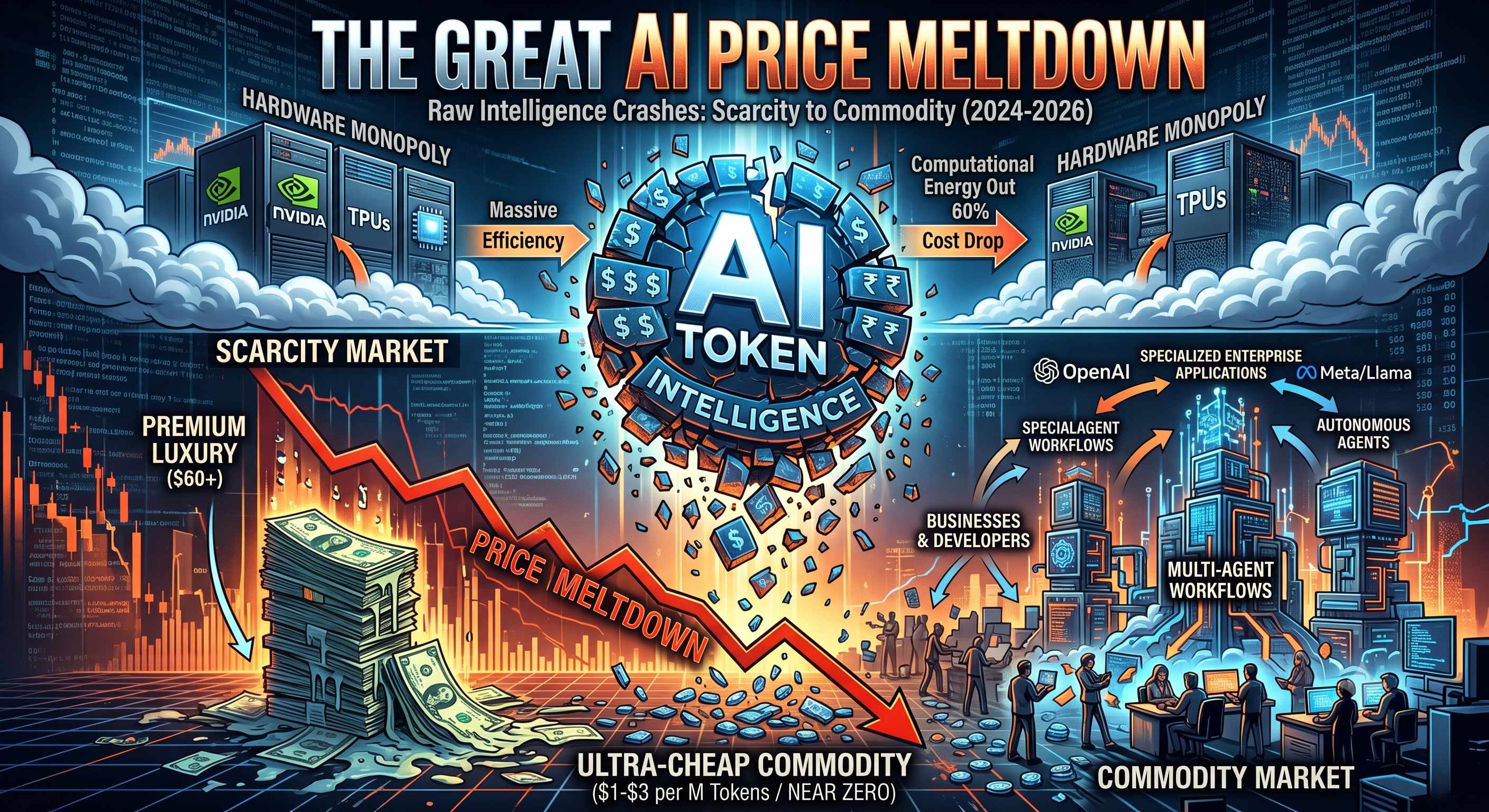
If you feel like the artificial intelligence landscape is changing faster than you can keep up with, you are completely right. But the biggest shift happening right now isn't about a new robot or a smarter chatbot—it is about money.
We are currently living through a hyper-competitive, aggressive price war among major AI providers. The cost of raw AI power (measured in "tokens," or pieces of words) is crashing toward zero.
Here is a simple, no-nonsense breakdown of exactly what is going on in the AI market, why it is happening, and what it means for the future.
What is the "Race to the Bottom"?
Think back to when flat-screen TVs first came out: they cost thousands of dollars and were a luxury. Today, you can buy a massive, high-definition TV for a fraction of that price because the technology became cheap and easy to manufacture.
AI is experiencing the exact same thing, but at warp speed. Tech giants and startups are slashing their API (Application Programming Interface) token prices by 90% to 97% compared to just a couple of years ago.
-
2024: Running complex AI tasks cost around $60 per million tokens.
-
2026: Equivalent or better frontier intelligence has collapsed to a window of just $1 to $3 per million tokens, with mid-tier models becoming virtually free.
The Core Drivers Behind the Crash
Why are these prices dropping so fast? It comes down to three major factors:
1. Massive Hardware and Engineering Efficiencies
Hardware providers are driving down the cost of processing chips by 60% to 70% annually. Newer microchip architectures (like Nvidia's Blackwell, advanced Google TPUs, and AMD chips) allow data centers to process exponentially more data using less electricity. At the same time, companies are using software tricks like quantization—running models on lower mathematical precision—which shrinks the memory footprint of a model by 75% without losing accuracy.
2. Models are Becoming Interchangeable
Enterprises have realized that "premium" models are highly substitutable. If OpenAI’s GPT-4o is too expensive, developers can instantly swap their API keys to Anthropic’s Claude, Google’s Gemini, or powerful open-source models like Meta's Llama. Because companies can switch so easily, AI providers have no choice but to cut prices to keep their customers.
3. The "Tokenmaxxing" Budget Hangover
Over the past year, major corporations went into an AI frenzy, trying to automate everything at once—a trend called "tokenmaxxing." For instance, companies like Uber reported maxing out their entire annual AI budgets in just the first few months because their developers delegated massive, automated coding workflows to AI. This triggered a corporate backlash against overusing expensive tokens, forcing AI vendors to lower rates to keep enterprise clients active.
Key Competitors and Their Strategies
AI ProviderRecent Strategy & Pricing ShiftPrimary TargetOpenAIActively slashing central API token prices to stay ahead of the curve.Poaching enterprise customers directly from competitors.Anthropic & GoogleDrastically cut costs (e.g., Google’s Gemini Flash line costs pennies; Anthropic cut prices by up to 67%).Locking in massive corporate developers and enterprise tech stacks.Sarvam AIIndian startup that optimized its serving stack to pass a massive 67% cost reduction (dropping from ₹1.5 to ₹0.5 per page) straight to users.Dominating sovereign cloud and high-volume vernacular digitization.Open-Source (Meta/Llama)Giving away highly capable model blueprints for free that companies can host on their own servers.Forcing proprietary vendors to drop their prices to stay relevant.
Where is the Market Headed Next?
The shift from a scarcity market (where AI was rare and expensive) to a commodity market (where raw AI is cheap and abundant) changes who wins and who loses.
The Ultimate Winners: Businesses and Developers
Because the cost of experimentation has dropped to near zero, developers can now build complex, multi-step "agentic workflows" (AI systems that can think, critique themselves, call external tools, and execute full tasks autonomously) without breaking the bank.
The standard corporate playbook is shifting to a Hybrid Model Topology:
-
80% of tasks (like data sorting, simple customer routing, and text translation) are sent to ultra-cheap or free mid-tier models.
-
20% of tasks (like complex legal analysis or deep strategic reasoning) are reserved for premium frontier models.
The Survival Plan for AI Labs: The "App Store" Pivot
Because foundational model providers can no longer survive just by selling raw access to intelligent text, they are shifting their business models. To survive, they are building walled ecosystems focused on specialized enterprise tools, bulletproof data security, and seamless workflow integration.
The New Golden Rule of AI: As raw intelligence hits the price floor, AI providers can no longer compete on price alone. Survival now belongs to whoever provides the best data security, deepest domain reasoning, and easiest user experience.
Would you like to explore how developers are building these advanced multi-agent workflows using cheap tokens, or should we look at the hardware advances making these low costs possible?
Comments (0)
Loading comments...