
Meet "LineShine": The New King of Supercomputing Hailing From China
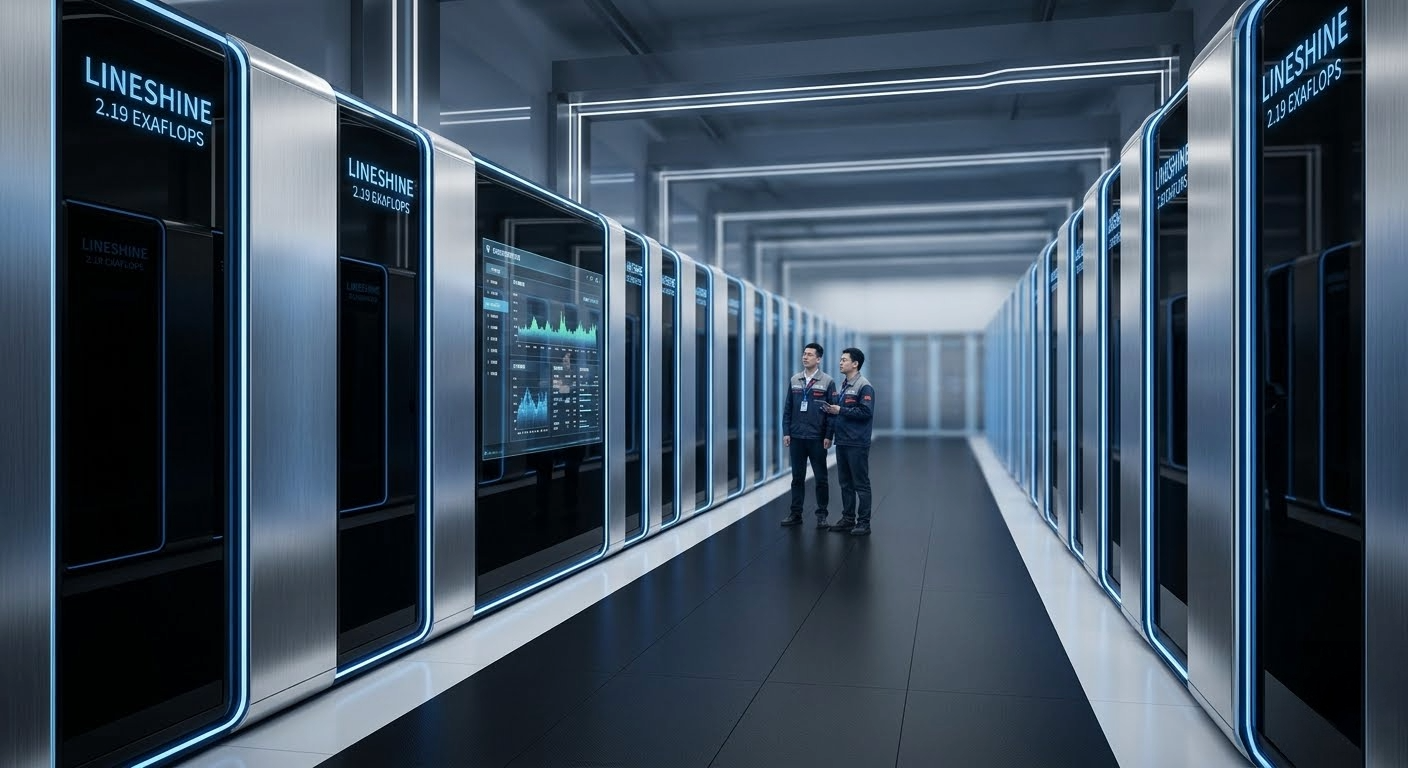
The global tech landscape has a new ruler. China's newly unveiled LineShine supercomputer has officially claimed the title of the world's fastest supercomputer, dethroning the United States for the first time since 2017. Housed at the National Supercomputing Centre in the tech hub of Shenzhen, this digital beast made its grand debut by shaking up the global rankings.
What makes this achievement genuinely fascinating is not just its record-breaking speed, but the way it was built. It challenges the fundamental rules of modern computer engineering.
Let us break down what this means in simple, easy-to-understand terms.
Just How Fast is the New King?
To understand how powerful LineShine is, we need to talk about Exaflops.
In normal life, we measure computer speed by how many calculations it can do in one second. A standard laptop can handle a few billion. LineShine, however, clocks in at an astonishing 2.19 exaflops.
- The Math: One exaflop is equal to one quintillion calculations per second.
- The Reality: LineShine handles over 2 quintillion math problems every single second.
- The Comparison: It is roughly 20% faster than the previous American crown-holder, El Capitan.
What Makes It Different (And Better) Than the Rest?
Most modern supercomputers and AI systems rely heavily on GPUs (Graphics Processing Units)—the specialized chips made famous by companies like Nvidia.
LineShine completely flips the script:
1. Powered Entirely by CPUs
Instead of relying on hard-to-get GPUs, Chinese engineers built LineShine using standard microprocessors (CPUs). Think of it like building the world's fastest race car using a massive network of standard car engines tuned to absolute perfection.
2. Fully Homegrown Tech
Due to strict international trade curbs and chip export bans, China could not buy the western market's highest-end AI chips. Instead, they engineered their own domestically designed, custom chips. This massive system links together nearly 14 million processing cores to act as a single unit.
3. Pure Focus on "Hard" Science
While US tech companies are heavily focused on building systems optimized for commercial AI models (like chatbots and image generators), LineShine is a scientific purist. It is built for complex, high-precision mathematics (64-bit data computing), making it exceptionally stable for raw scientific simulations.
What Will This Supercomputer Actually Do?
Supercomputers are not built to browse the web or play video games. They are used to solve problems that would take a normal computer thousands of years to calculate. According to data tracked by global technology reports, LineShine will be deployed for several critical tasks:
- Medicine & Drug Discovery: Simulating how complex molecules interact to discover life-saving vaccines in days rather than decades.
- Climate & Weather Modeling: Creating hyper-accurate simulations of global weather patterns to predict severe hurricanes and natural disasters far in advance.
- Deep Space Exploration: Analyzing gargantuan streams of data from space telescopes to map out black holes and the evolution of faraway galaxies.
The Takeaway
The arrival of LineShine on the TOP500 supercomputer list proves that hardware limitations can often breed incredible innovation. By bypassing the global GPU shortage and designing custom microprocessors from scratch, the new king has rewritten the blueprint for high-performance computing.
Comments (0)
Loading comments...